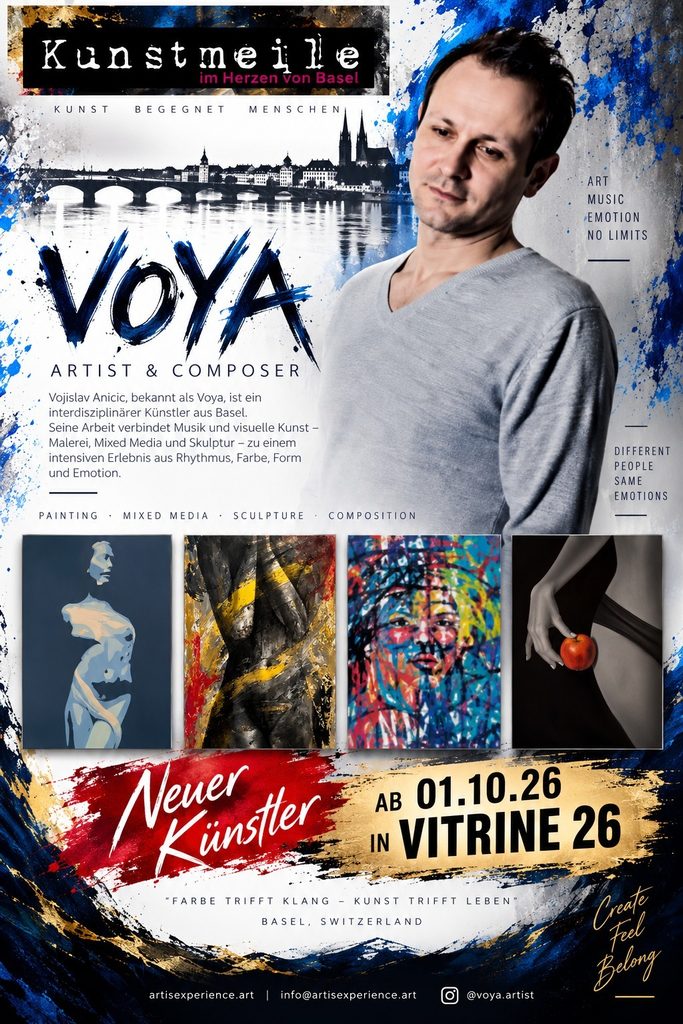
Vojislav Anicic, known professionally as Voya, is an interdisciplinary artist whose practice moves between music and the visual arts. Born in 1976 to a family of Balkan origins and raised in Switzerland, his life has been shaped by the encounter of different cultures, languages, and sensibilities. This interplay of influences has fostered a lasting fascination with contrast, complexity, and the many contradictions that define the human experience.
Trained in composition and orchestration at Berklee College of Music in Boston, Voya has composed music for more than 60 visual media projects, spanning film and immersive installations. His musical background continues to inform his visual practice. For him, composing with sound and painting with colour are different means of pursuing a common impulse: to give form to an experience, an emotion, or an idea. Rhythm, harmony, gesture, and texture become elements of a shared artistic language.
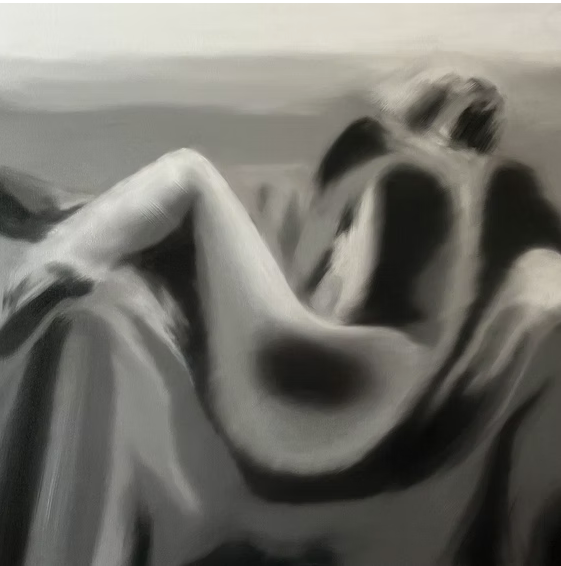
Working across painting, mixed media, and sculpture, Voya explores a broad spectrum of visual expression, from figurative realism to abstraction. Informed by the legacies of Monet, Kandinsky, Sargent, Richter, and Saville, his work moves between observation and interpretation, the tangible and the ephemeral. Portraiture, the human figure, and landscape become vehicles for examining presence, perception, and the complexities of human experience. Throughout his work, contrasts emerge as a recurring thread: between restraint and intensity, structure and spontaneity, recognition and abstraction.
Based in Basel, Switzerland, Voya works from vstudios, an independent creative space that reflects his multidisciplinary approach. His practice is rooted in the conviction that seemingly opposing forces need not resolve into a single truth. Instead, their coexistence can reveal new perspectives and deeper layers of meaning.
For Voya, art is not simply an object to be observed, but an experience to be encountered. Whether through sound or image, his work explores the tensions and harmonies that shape our inner and outer worlds, inviting a personal engagement with sensation, memory, and emotion. The result is an open space for reflection, where contradiction becomes a source of expression and complexity an invitation to look more closely.